Milan: Indigenous protesters link Italian leather industry to destruction of their uncontacted relatives’ forests
April 24, 2026
- Campaigners denounce Italian Tanneries Association’s refusal to meet Indigenous delegation
- Vatican, Italian parliament and Foreign Affairs Ministry receive Indigenous representatives
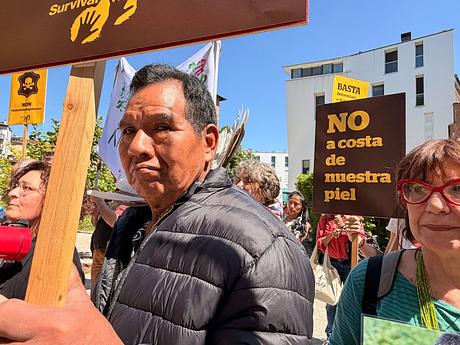
Indigenous people and their supporters have protested in Milan to highlight the connection between Italy’s leather industry and its impact on uncontacted people in Paraguay.
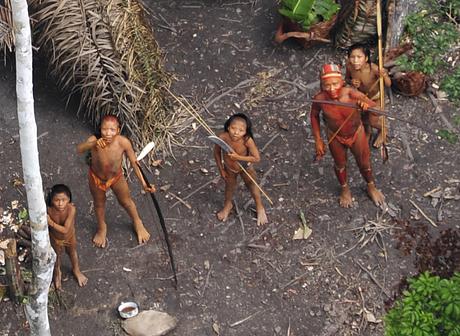
Research by Earthsight revealed that leather produced on illegal cattle ranches inside the territory of Paraguay’s uncontacted Ayoreo Totobiegosode Indigenous people is being bought by European leather manufacturers.
Italy imports over 50% of all Paraguayan leather production — some of which is used in the manufacture of luxury cars, furniture and clothing.
Totobiegosode representatives Porai Picanerai and Darajidi Picanerai, along with Survival International, protested Friday outside the Italian Tanneries Association (UNIC: Unione delle concerie italiane).
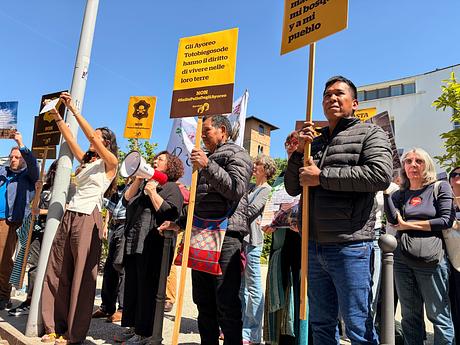
They had requested a meeting with the trade body to demand that its members stop importing leather from Paraguay, as it’s impossible to certify the leather does not come from illegal cattle ranches inside uncontacted Ayoreo Totobiegosode territory. The Association refused to meet them, though its Director General Fulvia Bacchi accepted a letter from the protesters .
In contrast, the Indigenous delegation was welcomed by the Vatican’s Pontifical Commission for Latin America, by Italy’s Foreign Affairs Ministry, and by the Human Rights Committee of Italy’s Chamber of Deputies.
The Committee pledged to support the appeal of the Ayoreo and the representatives of Survival International Italy who accompanied them.
Pasubio, one of Italy’s largest leather manufacturers, stopped importing Paraguayan leather in 2023 because of these human rights concerns, following discussions with Survival International.
The Ayoreo Totobiegosode territory lies inside Paraguay’s Chaco region, where the forests are being destroyed faster than anywhere else in the world.
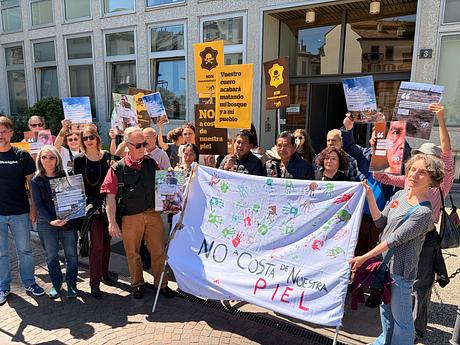
Porai Picanerai said to European consumers today : “Please make sure that the leather you buy doesn’t come from deforested Indigenous territories. I think that if the people here knew that our people (our uncontacted relatives) might die soon because of deforestation, if they are decent people, they wouldn’t want to buy Paraguayan leather.”
Darajidi Picanerai said today: “There is a great deal of deforestation in our territory, and we and our isolated brothers and sisters need the forest to survive. We have come to ask for your help, because in our country no one listens to us. The whole of the Chaco is riddled with deforestation and cattle raised for meat and leather. We have learnt that your country, Italy, buys the leather from these cattle. We want to ask you, please, not to buy that leather any more, until the Indigenous territories are in Indigenous hands.”
Francesca Casella, Director of Survival International (Italy) said today: “This isn’t a campaign against leather, it’s about the total destruction of Indigenous peoples’ forest. Survival International calls on Italy’s tannery companies to stop importing leather which is the result of criminal activity on land that should be returned to its rightful Indigenous owners. The industry must take moral responsibility for a supply chain which ruins the environment and steals from the Ayoreo Totobiegosode people.
“It's more than just a principle. For Ayoreo groups and their uncontacted relatives, it’s the difference between life and death.”
Note to Editors:
- The Ayoreo people number some 5,000, living in both Paraguay and Bolivia. They are divided into various sub-groups. One of these, known as the Ayoreo Totobiegosode, were forcibly contacted from 1979 onwards, in manhunts organised by the evangelical New Tribes Mission. Porai and Darajidi are members of this group. Other Totobiegosode people resist contact to this day, and live in a small area of forest in W Paraguay which survives amidst a sea of deforestation. The contacted Ayoreo Totobiegosode people have been claiming formal, legal ownership of this area since 1993, to protect the heartland of their territory, and their uncontacted relatives who continue to live in the forest. They have secured legal title to some of the land, but Paraguay’s government has allowed much of the area to be destroyed for cattle ranching and agribusiness.
- A study by the University of Maryland, which analysed global data from 2000 to 2024, confirms that the forests of the Paraguayan Chaco continue to experience the highest rate of deforestation in the world.
- In its recent report “Uncontacted Indigenous Peoples: at the edge of survival”, Survival revealed that half the world’s 196 uncontacted peoples could be wiped out within 10 years unless urgent action is taken.